What Is MetaDAO
If you’ve been frustrated with traditional DAOs, you’re not alone. Most DAOs rely on voting, which often leads to apathy, slow decisions, or even manipulations by whales. That’s where MetaDAO comes in. Built on Solana, MetaDAO is a decentralized fundraising and governance platform that turns decision-making into a market-driven system.
Instead of counting votes, MetaDAO uses Futarchy.
Simply put: Vote on values, bet on beliefs.
If you think a proposal, say hiring a new marketing team, will raise the token’s value, you bet on it. If the market agrees, the proposal passes automatically.
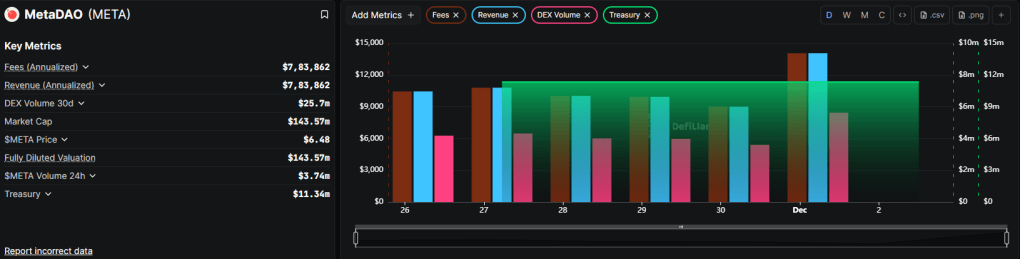
MetaDAO isn’t just theory. Since its launch in 2023, it has handled 96+ proposals across 14 DAOs, far outpacing competitors like FutureDAO or Drift, which only had 4 each. As of Q4 2025, MetaDAO has a market cap of $115M–$135M, daily trading volumes of $2M–$4M, and over 4,300 active holders. Quarterly revenue from transaction fees alone was $21,240, proof that this it’s a working fundraising platform.
This model turns any DAO into a prediction markets crypto powerhouse. Every action is measured by its predicted impact on token value. Community engagement is automatic, decisions are clear, and founders can focus on growth not endless debates.
As a development agency, we can build your custom MetaDAO solution, fully branded and adapted for your token. Using the MetaDAO futarchy model, we integrate Solana DAO governance, prediction markets crypto, and conditional tokens Solana, giving your project a white-label solution that scales.
In short, we don’t just deploy a DAO, we build a market-driven governance system that works.
MetaDAO is more than a governance tool. It’s a game-changing launchpad, a fundraising platform, and a DAO governance solution that ensures only smart, market-approved actions get executed. For founders, this is the future of on-chain decision-making.
How MetaDAO Actually Works
MetaDAO replaces normal voting with prediction markets. Instead of people voting with emotions, traders vote with money, so the market decides what is actually good for the DAO.
It works like this:
A member creates a proposal, for example: Hire Agency X for $50k. This proposal includes a real Solana instruction that can run on-chain.
The Autocrat program then creates two markets:
- Pass Market: What the token price would be if the proposal passes
- Fail Market: What the token price would be if the proposal fails
People begin trading in both markets. If they think the proposal will make the project stronger, they buy the Pass market. If they think it will hurt the project, they buy the Fail market.
After a few days, MetaDAO checks the average price (TWAP). Whichever market shows a higher price becomes the true reality.
- If Pass > Fail, the proposal executes on-chain automatically
- If Fail > Pass, the proposal is rejected
There is no drama or politics. The market chooses the best path for the DAO.
And the best part is that the losing market is unwound, so traders get their money back in that unreal world. You only lose if you bet wrong in the reality that actually happens.
How MetaDAO’s Fundraising Model Works
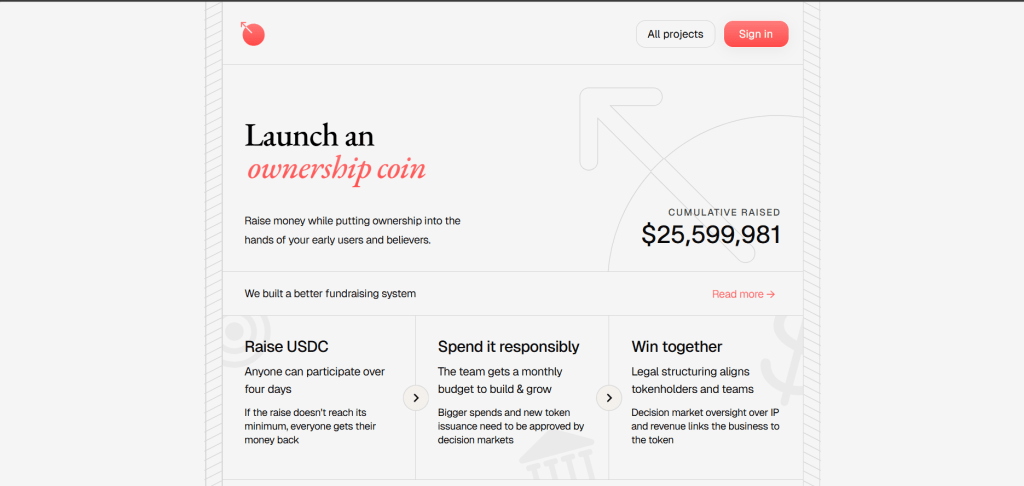
MetaDAO’s fundraising is fair, transparent, and hype-driven. It uses a 4-day USDC window where anyone can commit. If too many people join, the system gives pro-rata refunds, so whales cannot control supply.
Example: If $5M is committed but the founder sets a $2M cap, then 40% is refunded and everyone still gets tokens.
After the sale:
- 80% goes straight to the DAO treasury
- 20% + 2.9M tokens are added to liquidity on Raydium/Jupiter
- Trading starts on Day 1 with strong liquidity
Founder tokens unlock only when big milestones hit (2x–32x) and this keeps founders aligned for the long term. This model has already proven insane results:
- Avici: Raised $35M but capped it, refunded $31.5M → exploded to $98M FDV
- Solomon: $102M committed on an $8M cap → massive demand without dumping
This is why X calls it the most fair launch model in crypto.
| ICO Parameter | Default/Range | Impact Example | Recent X Insight |
| Commitment Window | 4 days | Urgency + broad participation | @game_for_one: Monitors for quick bets |
| Token Supply | 10M initial (high float) | Instant liquidity, no cliffs | $UMBRA: Privacy protocol raised via futarchy |
| Discretionary Cap | Founder-set (e.g., 20-50% of bids) | Controlled growth | Solomon: $8M cap on $102M |
| LP Allocation | 20% auto + 2.9M tokens | Day-1 trading | Use Jupiter over DexScreener for accuracy |
| Founder Unlocks | Performance-based (18+ months vest) | Incentive alignment | Avici: 20x without early dumps |
On the fundraising side, MetaDAO also reinvented ICOs. Projects run a 4-day USDC commitment window, set their own cap, refund extra bids, and send 80% to the treasury + 20% to auto-LP for day-one liquidity.
| Proposal Type | Stake Req. | Resolution | Example Outcome |
| Treasury Spend (e.g., hires) | 500K tokens | TWAP yes/no >50% | Loyal: Bet-driven rebalance for floor |
| Token Mint | 500K tokens | Market predicts +EV? | Performance unlocks at 2x-32x |
| Metadata/LP Adjust | 500K tokens | Quick TWAP | Auto-LP on Jupiter |
| IP/M&A | Via MetaLex | Co-approval | Bans equity issuance |
This model has already produced huge wins, from Avici’s 20x launch to Solomon’s $100M+ demand all without VC dumps. When the raise ends, anyone with 500K tokens can open a proposal for spending, minting, LP changes, or governance rules.
Prediction markets decide everything. Decisions become faster, cleaner, and aligned with real value.
MetaDAO turns DAOs into self-adjusting, market-powered machines and as a dev agency, we can build this entire system for your project with a white-label MetaDAO solution.
How to Use MetaDAO
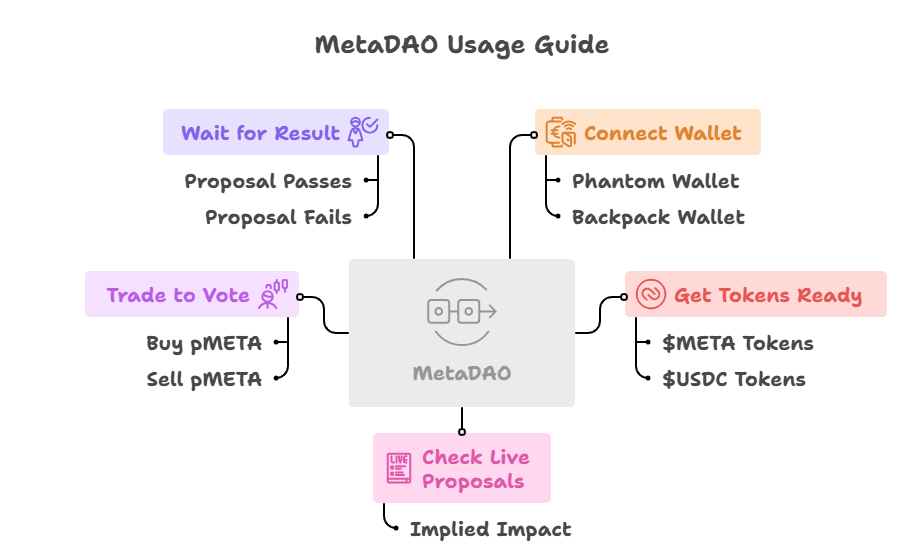
Using MetaDAO is actually very simple, even though the tech behind it like Futarchy, Solana, prediction markets is powerful. Here’s how anyone can use it:
1. Connect Your Wallet
Users log in with a Solana wallet like Phantom or Backpack on the MetaDAO app. No signup, no KYC, just fast and smooth.
2. Get Your Tokens Ready
To take part in MetaDAO governance, users need $META and $USDC. These tokens power the prediction market and make the governance system work.
3. Check Live Proposals
Anyone can open the proposals page and see what decisions the DAO is voting on. MetaDAO also shows the Implied Impact basically the % difference between Pass vs Fail prices, so users instantly know which proposals the market thinks will help or hurt the ecosystem.
4. Trade to Vote
This is where MetaDAO becomes a game-changer:
- If you think a proposal will help the DAO, you buy pMETA (Pass-META).
- If you think it’s bad, you sell pMETA for pUSDC.
This is voting with real skin in the game, not blind opinion polls.
5. Wait for the Result
When the proposal closes:
- If it passes, your pMETA turns into real $META (profit).
- If it fails, your trade is null, and you get your funds back.
Simple, Fair and Market-driven.
How the MetaDAO Futarchy System Actually Works
MetaDAO looks simple on the surface, but underneath, it is a full economic engine built from three connected Solana programs. Each part has a clear job, and when they work together, they replace normal voting with market-driven truth.
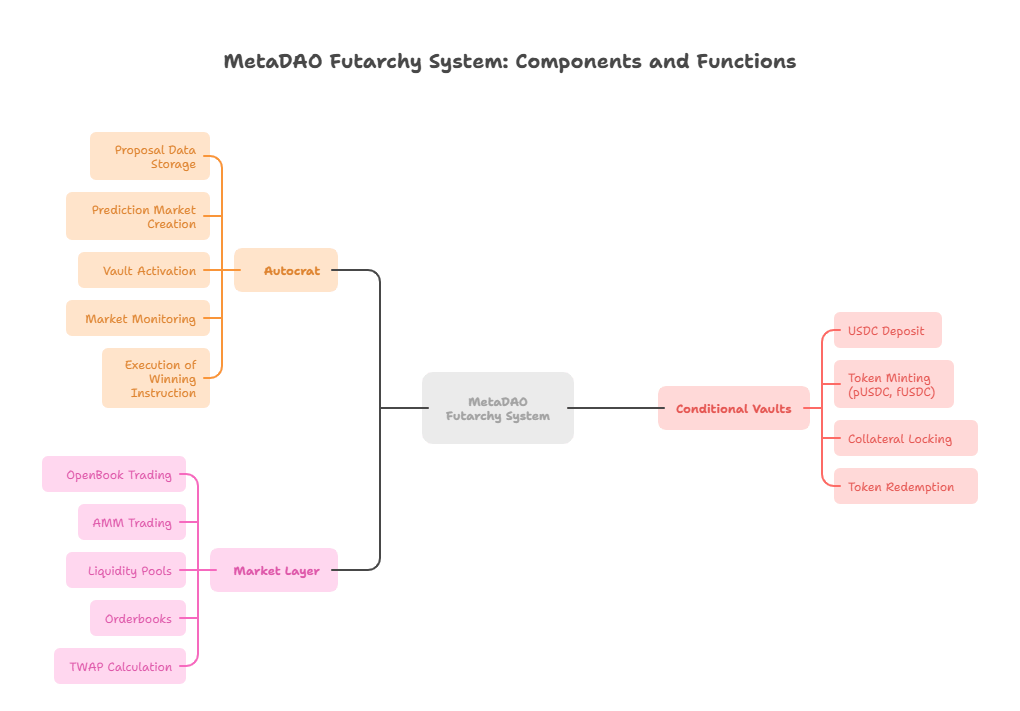
Here is the full breakdown of how the system truly works from start to finish.
1. Autocrat
Autocrat is the main controller program. Every action goes through it, and it decides when each step should happen. When a proposal is created, Autocrat:
- Stores the proposal data like what should happen if it passes.
- Creates two prediction markets for the decision.
- Activates the vault, which mints conditional tokens tied to the proposal.
- Waits for the market to move and show which outcome the traders believe in more.
- Executes the winning instruction on-chain once the market settles.
Autocrat doesn’t choose anything. It only listens to the final market price, then executes whatever outcome the market says is best.
Inside this program:
- The proposal ID connects to all market accounts.
- Deadlines define the trading window.
- A resolution handler ensures no one can cheat the outcome.
- A final execution instruction runs with no external permissions.
This keeps the system trustless and tamper-proof.
2. Conditional Vaults
The vault is where the magic happens. It takes real tokens and turns them into two new assets that represent the two sides of the proposal. Here’s the flow inside the vault:
- A user deposits USDC (or the chosen token).
- The vault locks the deposit.
- It mints:
- pUSDC — becomes valuable if the proposal passes.
- fUSDC — becomes valuable if the proposal fails.
- These two tokens go into the market to be traded.
- At the end, whichever side “wins” is redeemable for the locked collateral.
Both tokens are always backed 1:1 by real collateral But their price changes because people buy the side they believe will win. This creates a self-correcting economic system:
- If many people think the proposal is good → pUSDC goes up in price.
- If they think it is bad → fUSDC goes up.
- If opinions shift → prices react instantly.
The vault only cares about one thing – keeping the collateral safe and minting/burning tokens correctly.
At the end:
- The winning token is redeemable for the collateral.
- The losing token becomes worthless.
- The vault burns both tokens and releases the assets accordingly.
3. Market Layer
This is where conditional tokens are traded, usually through:
- OpenBook (central limit orderbook)
- AMMs (if the client chooses a liquidity pool model)
The market is not just trading. It is the system that decides the final outcome.
Price = collective belief.
Some deeper mechanisms that run here:
- Liquidity pools allow constant buying/selling.
- Orderbooks allow deep bids/asks and real price discovery.
- TWAP (time-weighted average price) protects from manipulation.
- Market depth reflects how confident the ecosystem is in the outcome.
- Resolution checks confirm final prices before execution.
Once the trading window closes, the final TWAP from these markets tells Autocrat which token is worth more. Whichever conditional token has higher value is the one that wins.
Conclusion
Using MetaDAO is simple when you understand the flow. If you’re a founder, you can launch your idea on metadao.fi by sharing your pitch, cap, and budget. You can track everything through Jupiter, and after launch, you can stake on proposals like how @game_for_one grew Loyal Watch through community-backed decisions.
If you’re an investor, you can add USDC, trade the prediction markets, and earn SOAR points for long-term loyalty.
As a Development agency, we build fully custom MetaDAO-style systems. We use Rust/Anchor for on-chain logic, Switchboard TWAPs for oracles, SNARK-based anti-sybil tools for security, and clean React dashboards powered by Helius RPCs for speed.
We deliver working prototypes in 4 weeks (~$50K) and run audits through Colosseum, helping projects reach real market gains. Even though futarchy still faces volatility, MetaDAO’s 2025 results show one thing clearly, market-driven governance works. It’s fast becoming Solana’s new standard for fair, aligned, and transparent decision-making.
If you want to build a platform like MetaDAO or a better version, reach out. We can design, develop, and launch the full system for you.

Connect with us on LinkedIn or Telegram and Let’s build your MetaDAO.
See you in the trenches.

Leave a comment