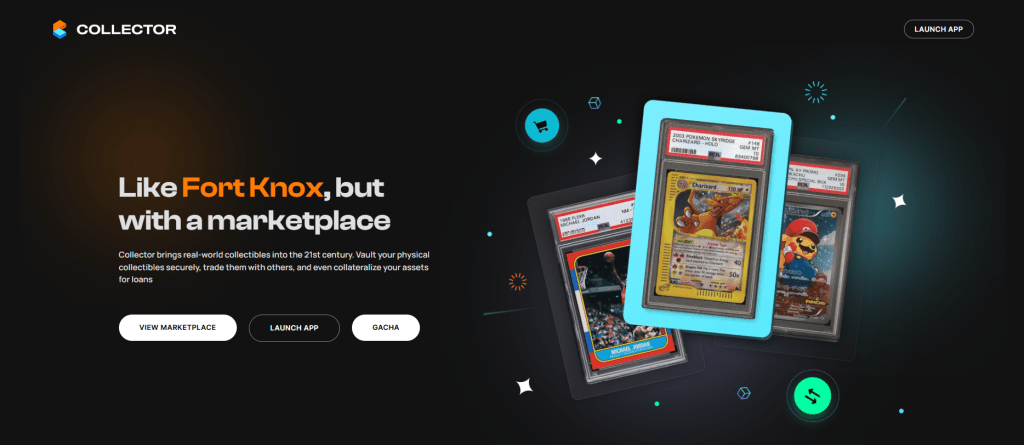
Remember how exciting it was to open a Pokémon pack when you were young, Your hands shook as you hoped to find that rare Charizard.
Now, CollectorCrypt brings back that excitement, but now you can measure and trade it.
The best part is no more waiting, guessing, or worrying about fakes. Every card has a token. It stays in a secure vault. Each card also has the backing of Solana blockchain.
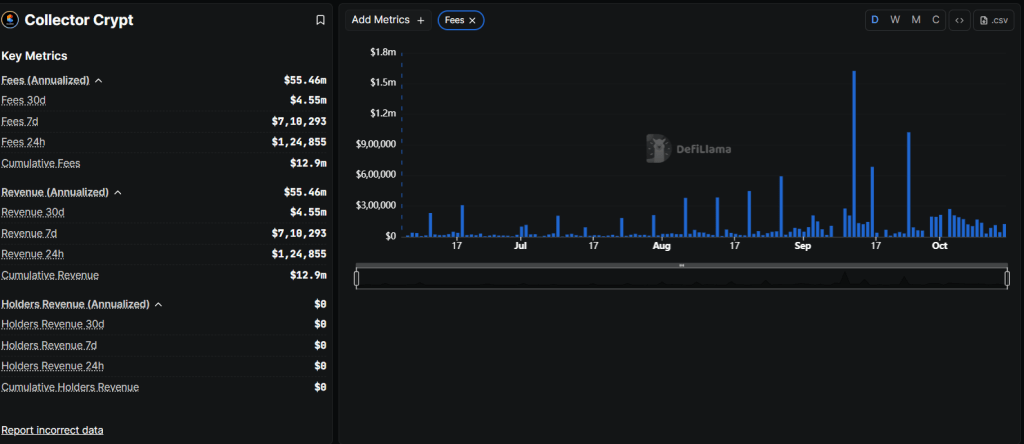
This gives collectors a guaranteed value and lets them trade worldwide right away. With $55 million in sales and a lively group of fans bringing in $4.5 million each month, this isn’t just about old memories. It shows how to turn what you love into a booming, blockchain-based market.
We all know that physical collectibles have always been a pain. Scarce cards autographed items, and special-edition collections are stuck in slow auctions unclear pricing, and sneaky fees.
Collectors get annoyed, and creators find it tough to set up easy-to-trade reliable markets. Each hold-up and each priced auction means less buzz and less money. That’s why a system like CollectorCrypt shakes things up.
It does more than turn cards into digital assets, it makes owning them feel like a game. Users get excited about opening packs. These packs work like Gacha games but offer good value. A promise to buy back cards ensures they won’t lose money.
According to me , This is the best way to revive NFT Market.
In just a few months, the platform saw over $55 million in sales. This success shows that when you mix actual items with clear pricing, you build more than a place to buy and sell. You also create ways for people to join in. You create something people believe in and enjoy.

The takeaway for founders and developers is straightforward. By implementing CollectorCrypt-type pNFTs, oracle-driven pricing, and game-like engagement, you can energize your protocol. This approach turns inactive assets into lively easy-to-trade economies.This approach gives users thrill, understanding, and trust while accessing the $400 billion collectibles market.
When you honor the collector’s passion and pair it with clever Web3 systems, positive outcomes occur. Your platform benefits, and your users do as well. Let me show you how you can do it and how they did it.
What CollectorCrypt Does?
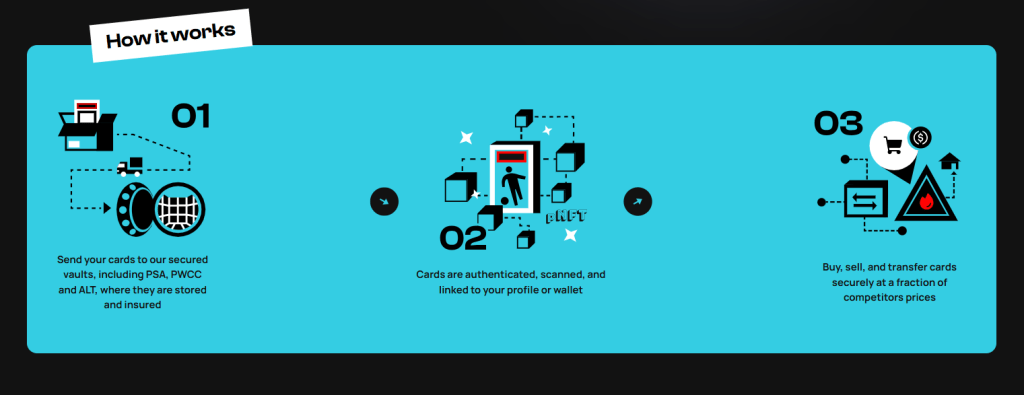
CollectorCrypt takes real-world collectible cards and turns them into digital NFTs you can trade, while keeping the physical cards safe.
Here’s how it works step by step:
- Send Your Graded Cards: Users submit professionally graded cards (PSA, BGS, CGC, etc.) to the platform. These are cards that already have verified quality and authenticity.
- Safe Storage: All cards are stored in secure, insured vaults with climate control and monitoring, so collectors never worry about damage, loss, or theft.
- NFT Minting: Once a card is verified in the vault, CollectorCrypt mints an NFT that represents the exact physical card. This NFT proves ownership on-chain.
- Instant Trading or Redemption: Users can trade the NFT instantly on the blockchain marketplace or redeem it at any time to get their physical card shipped safely. This combines the best of both digital and real-world markets.
- Gacha Pack Mechanics: CollectorCrypt also offers Gacha-style packs, where users buy randomized card packs. Each pack shows transparent odds and has a positive expected value, so it’s designed to give real collector value, not just gambling.
- Buybacks for Liquidity: Users can sell cards back to the platform at 85–90% of market value, ensuring that every NFT or card has liquidity and that collectors never get stuck with illiquid assets.
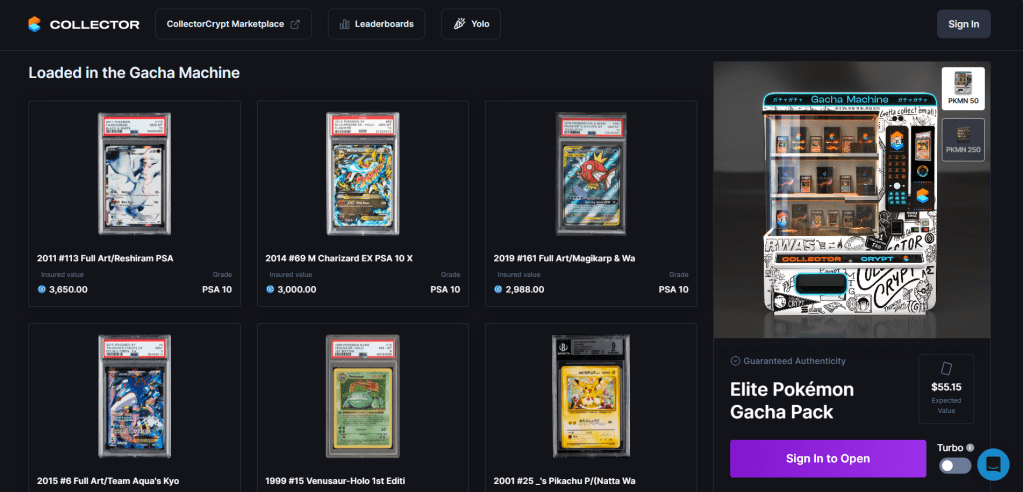
How CollectorCrypt Work and Turn Real Collectibles into On-Chain Assets
CollectorCrypt combines grading, secure vaults, pNFTs, oracle-driven pricing, and gamified Gacha mechanics to create a trusted, fun, and highly liquid collectibles marketplace.
Users get excitement, value, and liquidity, while founders and builders see a blueprint for engaging and profitable RWA marketplaces.
Here’s how it works:
1. Grading & Vault Infrastructure
CollectorCrypt ensures trust and authenticity before any collectible becomes a pNFT.
1.1 Third-Party Grading
- Cards are authenticated and graded by leading agencies: PSA, BGS, or CGC.
- Grading evaluates centering, corners, edges, and surface condition, assigning scores from 1–10.
- This step ensures provenance and verified value, essential for collectors and investors.
1.2 Climate-Controlled Vaults
- These measures reduce fraud, loss, and storage risks, making on-chain ownership trustworthy.
- Graded cards are stored in insured, monitored facilities (e.g., PWCC, ALT).
- Each card has photo audits, GPS tracking, and climate control logs.
- Vault attestations are fed into oracles, which confirm the physical presence and condition of each card before minting a pNFT.
2. pNFT Smart Contracts
Once cards are vaulted, they are minted as physical-backed NFTs (pNFTs) with verified metadata.
2.1 Metadata & On-Chain Schema
- Immutable fields include:
- Card grade
- Grading agency ID
- Vault location
- Insurance certificate hash
- Timestamp of minting
- This ensures traceable ownership and verifiable value, critical for investor confidence.
2.2 Minting Workflow
- Vault confirmations are verified through oracles (e.g., Pyth Network, DIA).
- Smart contracts mint 1:1 unique pNFTs with:
- Sub-cent Solana fees
- <1 second finality for trades
- Each pNFT is a digital twin of a physical card, providing liquidity without removing the asset from secure custody.
2.3 Burn & Redemption
This mechanism maintains treasury revenue while ensuring users can access real assets anytime.
- Holders can burn pNFTs to redeem the physical card.
- Fees: 2% vault withdrawal & shipping.
3. Oracle & Pricing Feeds
Liquidity and fair pricing are maintained via dynamic oracle feeds.
3.1 Data Aggregation
- Oracles pull real-time pricing from:
- eBay
- ALT marketplace
- Integrated trading platforms
- Updates occur every minute, reflecting true market value for buybacks and trades.
3.2 Instant Buyback Protocol
- Buybacks are automatically calculated using median prices ±2% slippage.
- Buyback rates: 85–90% of market value.
- Ensures:
- Continuous liquidity
- Soft price floors
- User trust in platform reliability
4. Gacha Mechanics & Pack Economics
CollectorCrypt gamifies engagement using Gacha-style pack unboxing, but with positive expected value (EV).
4.1 Pack Types & Probabilities
| Pack Name | Price (USDC) | Probabilities | Buyback Rate |
|---|---|---|---|
| Commons Pack | 10 | Common 80%, Uncommon 15%, Rare 4%, Epic 1% | 80% |
| Uncommon Pack | 25 | Uncommon 75%, Rare 20%, Epic 4%, Legendary 1% | 85% |
| Legendary Pack | 50 | Uncommon 75%, Rare 20%, Epic 4%, Legendary 1% | 90% |
- Packs are designed for repeated engagement, with average EV +5–10%.
- Community-voted themes increase excitement (e.g., Gengar, Rayquaza runs).
4.2 Revenue & Volume Insights
- Monthly trading surged from $22M (Jan 2025) to $124.5M (Aug 2025).
- Total platform revenue in 2025: $89M+, with daily peaks of $3M.
- Average pNFT trades 8 times/month, boosting token velocity and annualized revenue.
4.3 Treasury & Inventory
- 100% of token sales fund physical inventory, aligning digital and real-world supply.
- Approximately 80% of tokens remain unvested, balancing growth vs. dilution risk.
5. Marketplace Mechanics
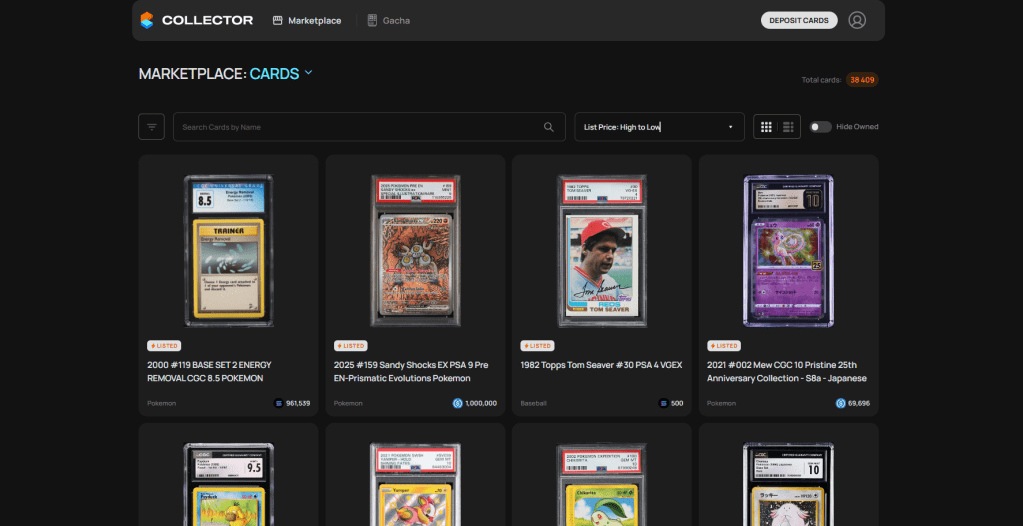
CollectorCrypt’s marketplace ensures fast, transparent, and global trading.
5.1 Trading Features
- Instant buying, selling, and listing of pNFTs
- Integration with Magic Eden, Raydium for broader liquidity
- Automated eBay-style bidding: processed $10M+ in bids, saving users $500K+
5.2 Global Reach & Security
- Ships to 30+ countries with on-chain tracking
- Smart contracts audited and secure (CARDSccUMFKoPRZxt5vt3ksUbxEFEcnZ3H2pd3dKxYjp)
5.3 Liquidity & Trust
- Buyback guarantees and oracle pricing create soft price floors
- Gamified packs and instant settlement reinforce user confidence and engagement
Why Other Protocols Should Care or Build This
Adding a module like CollectorCrypt to your project is more than just a fun feature, it’s a business advantage. Here is what Solana Said:
Here’s why other chains or platforms should pay attention:
| Advantage | Why It Matters |
|---|---|
| Differentiated utility | Most chains focus on DeFi, tokens, or gaming. Tokenized real-world assets (RWA) like collectibles open a new, less crowded space. |
| Strong user retention | Gamified mechanics like Gacha and pack openings keep users coming back, far more than one-off NFT drops. |
| Built-in liquidity & trust | With buyback guarantees, users know their NFT roughly equals the underlying asset value. This reduces fear and boosts confidence. |
| Organic growth flywheel | More users trading means more inventory, more content, and more users. It creates a self-reinforcing network effect. |
| Token alignment & revenue sharing | Proceeds can fund token buybacks, staking rewards, or governance, keeping the community invested and aligned with the project. |
| Cross-vertical opportunities | Once proven for cards, the model can expand to sneakers, art, collectibles, and other physical goods, unlocking new markets. |
So, Integrating tokenized collectibles isn’t just a feature, it’s a way to increase user engagement, build trust, and create new revenue streams.
For chains and projects, it’s a chance to stand out, grow organically, and tap into the $400B+ collectibles market.
How CollectorCrypt Grew to $114M YTD Revenue
Building a product like CollectorCrypt is tough Bur marketing it is near to impossible.
So,let me shows exactly how a strong community, transparency, and gamification can drive growth for them. By studying their approach, founders and builders can replicate it for their own projects.
TL:DR
- Start with Community: Discord and X are key to build early engagement.
- Be Transparent: Share metrics like trading volume, pack value, and user rewards.
- Gamify Participation: Offer surprise drops, Gacha packs, and positive expected value.
- Leverage Partnerships: Cross-project collaborations increase reach without paid ads.
- Reward Loyalty: Free spins, raffles, and content sharing encourage virality.
Core Approach
CollectorCrypt focused on organic growth, real utility, and community engagement instead of paid influencers. This approach helped them:
- Generate $114M in Gacha revenue YTD
- Build 76K+ X followers
- Create high retention users averaging $19K spend
Key to their success was making the experience fun, fair, and rewarding, not just selling collectibles.
How They Did It
1. Community-First Engagement
- Discord was the hub: exclusive announcements, polls for Gacha themes (e.g., Monster Friday), and early access.
- Users felt part of decisions, creating loyalty and organic word-of-mouth.
2. Transparency Builds Trust
- Shared key metrics like $4.2M daily volume and +12% expected value on packs.
- Users knew the platform was fair, which encouraged more buying and trading.
3. Gamified and Stealth Launches
- Surprise Gacha drops (like $2.3M in 2 hours) created FOMO.
- Raffles and free spins ($1.7M total) encouraged participation and sharing.
4. Smart Partnerships
- Collaborated with LootGO, Moonbirds, Pudgy Penguins, and exchanges like Binance.
- Partnerships extended reach, introduced cross-promotions, and added extra excitement.
5. Rewarding Content
- Giveaways, airdrops, and utility integration ($PENGU) rewarded users.
- Visuals like unboxing videos and card hauls drove higher engagement.
Timeline of Key Tactics (2024–2025)
| Time | Campaign | How It Worked | Outcome | X Link/Thread |
|---|---|---|---|---|
| Dec 2024 | TCG Giveaway | Booster box promos with free NFTs via Pudgy Penguins | Increased engagement and redemptions | X Post on Promo (simulated; actual from history) |
| Dec 2024 | White Elephant Airdrop | Holiday-themed rewards with cards/whisky via BAXUS | Viral cross-promo reach | X Post on Airdrop |
| Dec 2024 | $PENGU Raffle | Utility for Pudgy TCG box entries via Famous Foxes | Boosted adoption with 42.69 PENGU entry | X Post on Raffle |
| Aug 2025 | TGE Announcement | Pre-sale via Metaplex Genesis, 100% funds to RWA treasury | Built hype for $CARDS (298 likes) | X Post on TGE |
| Sep 2025 | Stealth Gacha | 2-hour surprise sale, no announcements | $2.3M revenue, organic buzz (324 likes) | X Post on Stealth |
| Oct 2025 | Community Vote | Monster Friday Gengar/Rayquaza poll | +12% EV packs, user-driven content (74 likes) | X Post on Vote |
| Oct 2025 | LootGO Collab | AR treasure hunt with Pokémon drops | Extended global reach (659 likes) | X Post on Collab |
| Oct 2025 | Largest Restock | $1M+ minted, 8,800+ cards | $3.5M on-chain value milestone (148 likes) | X Thread on Restock |
Ready to Build Your Own CollectorCrypt?
Turn your assets into on-chain, gamified, and redeemable experiences that drive engagement, loyalty, and revenue.
We can help you build and market it on other chain in 45 days.
Book a call now and let’s bring your project to life.
Conclusion
CollectorCrypt proves that real-world assets + blockchain + gamification can create high engagement, trust, and revenue. By focusing on community, transparency, and value-driven experiences, founders can turn static collectibles into dynamic, tradable ecosystems.
Whether it’s Pokémon cards, sports collectibles, or other RWAs, this model shows that utility and loyalty beat hype every time. Builders who replicate these strategies can achieve organic growth, strong retention, and scalable revenue.
FAQs
1. What is CollectorCrypt?
CollectorCrypt is a blockchain platform that turns physical collectibles mainly graded Pokémon cards into redeemable NFTs on Solana. Each NFT is backed 1:1 by a real, authenticated card stored in secure, insured vaults managed by partners like PWCC and ALT. This lets users trade digitally without shipping risks and redeem the physical card anytime. The platform solves problems like fraud, storage, and liquidity in traditional collecting. As of August 2025, it has processed $124M+ in trading volume. Its native $CARDS token powers purchases, rewards, and liquidity.
2. How does the Gacha system work?
The Gacha system is a fun, gamified way to open packs, like traditional Pokémon booster packs. Users buy randomized NFT packs priced $50–$250, with transparent odds and positive expected value (EV).
- Elite packs ($50–$60): ~20% chance of a big win, 85% buyback guarantee.
- Legendary packs ($250): ~25% chance of a big win, 90% buyback at market value.
Each pack contains NFTs linked to graded cards, which can be held, traded, or redeemed. Over 1M packs sold in 2025 have generated $89M in revenue. All NFTs are minted instantly on Solana with low fees, making collecting fast and easy.
3. How to set up an account and buy tokenized cards
- Sign up at collectorcrypt.com via email or Google.
- Complete KYC verification (required for redemptions).
- Set up a Solana wallet like Phantom, Solflare, or Bitget Wallet.
- Fund your wallet with SOL or USDC via exchanges, cards, or transfers.
- Browse the marketplace by grade, rarity, or collection, or buy through Gacha packs.
Transactions are instant and secure on Solana, with full NFT details, including photos, grades, and certification.
4. How to trade tokenized cards
Trade your NFT collectibles on CollectorCrypt or integrated Solana marketplaces like Magic Eden or OKX.
- List with full details for transparency.
- Buy/sell anytime with low fees (4%, cheaper than eBay’s 10–15%).
- Use instant buyback for quick liquidity (85–90% of market value).
- Supports global trading, fast transactions, and avoids shipping delays.
5. How to redeem your NFT for the physical card
To redeem:
- Select the NFT in your dashboard.
- Burn it on the blockchain (removes it from circulation).
- Provide shipping info and pay a 2% vault fee plus shipping.
- The physical card is shipped securely within 3–7 days, fully insured and trackable.
This ensures authenticity, and only one owner can claim the card.

Leave a comment